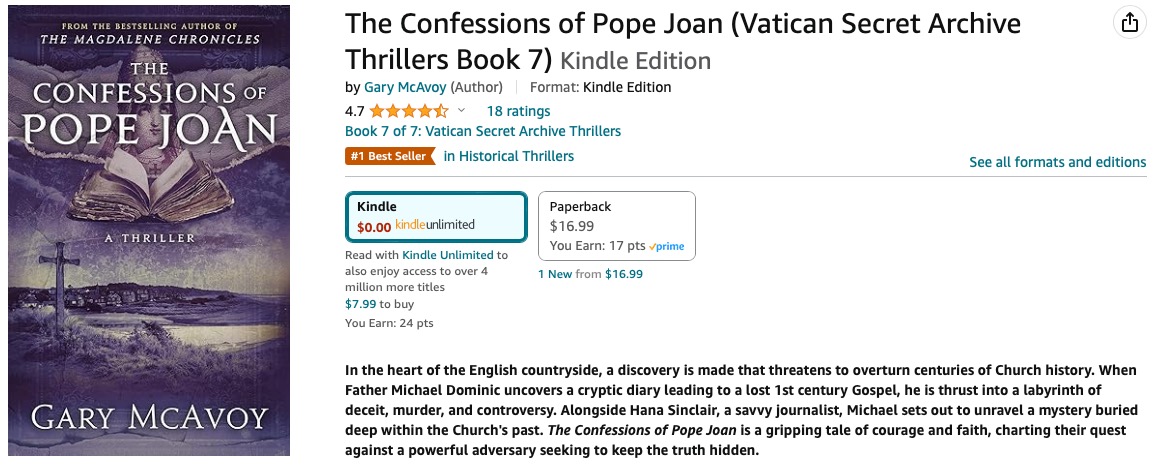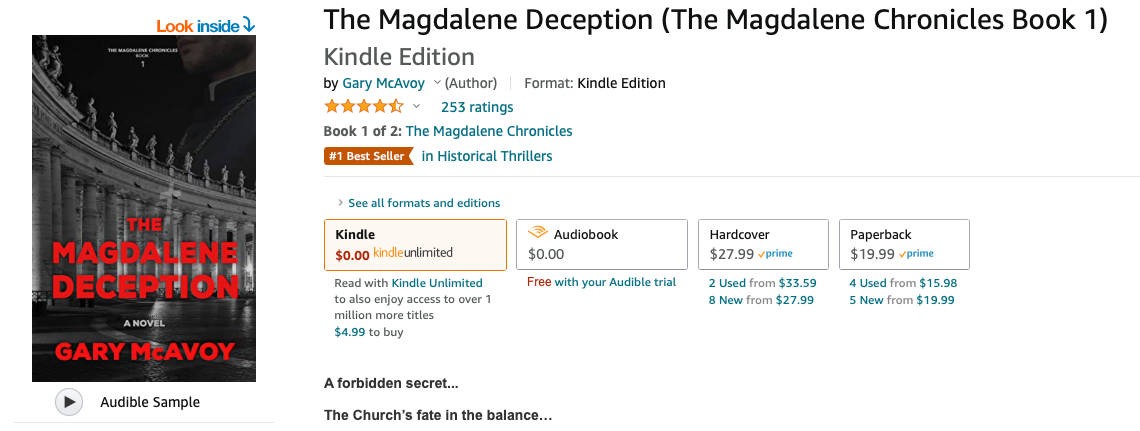
The Pompeian Betrayal

A Vatican Archaeology Thriller - Book 3

When Vatican archaeologist Marcus Russo receives an urgent call from Pompeii, he expects another routine excavation mystery. Instead, he finds something impossible: a hidden chamber containing symbols that predate their supposed origin by fifteen centuries. The seven-petaled rose, the geometric cross, the imagery that would become synonymous with Rosicrucianism—all of it painted on Roman walls decades before Vesuvius buried the city in ash. The discovery threatens to unravel one of history’s most enduring secrets: the Rosicrucian brotherhood wasn’t built on ancient wisdom passed down through the ages. It was built on a lie.

But powerful forces have protected that lie for four hundred years. The Fraternitas Rosae Crucis Aeternae will stop at nothing to bury the truth again—including burying Marcus and everyone who has seen the evidence. From the volcanic ruins of Pompeii to the shadowed halls of the Vatican, from Vienna’s elegant palaces to a besieged monastery in the Egyptian desert, Marcus and his team must outrun a conspiracy that spans centuries while decoding the teachings of a Roman philosopher who died rather than let his wisdom be corrupted. What Gaius Petronius Harmonia sealed in his underground sanctuary wasn’t just a meditation practice. It was a message: some truths are too dangerous to transmit—and too important to destroy.

The third installment in the Vatican Secret Archive Thrillers series, The Pompeian Betrayal weaves archaeological mystery, institutional conspiracy, and ancient philosophy into a pulse-pounding adventure that asks: What happens when the foundations of a centuries-old tradition are revealed as a magnificent mistake? And what wisdom might be waiting, patient and silent, for seekers brave enough to dig it up?
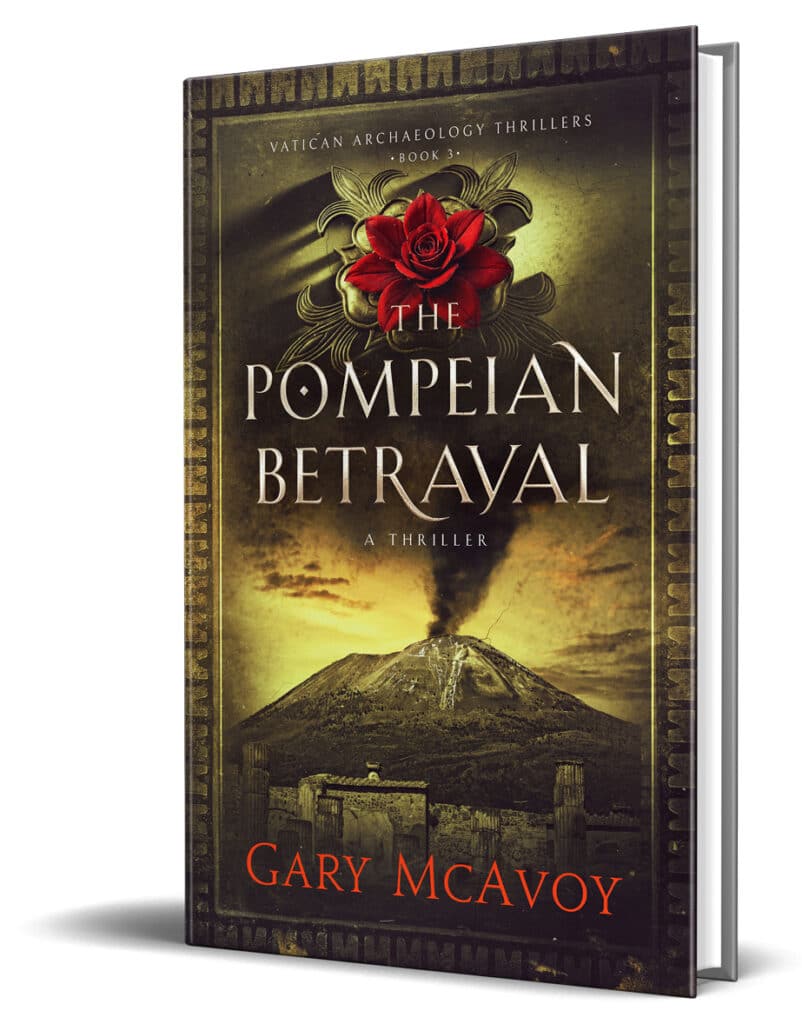
Coming April 2026

Advance Reader Reviews

“In Gary McAvoy’s new Vatican Archaeology Thriller, “The Pompeian Betrayal”, we again join the beloved characters from the Vatican Secret Archives series in another roller-coaster adventure through history, time, exotic locales, truth v. myth and the inescapable religious/philosophical questions–whose answers many times depend on each individual’s perception.
 
How do you react when a 2,000 year old discovery in Pompeii changes the faith of an entire organization for over 400 years?  Well, leave it up to McAvoy to exquisitely provide the background, philosophy and adventure–as well as the physical/emotional challenges with well defined antagonists–and how each primary character reacts and is changed by the discovery–even at the risk of your own life.
 
A highly recommended read, especially if you are a fan of the book series and enjoy the wonderful historical speculative world created by Gary McAvoy.” —MAURO PANZERA, Beta Reader

“I’ll make a bold claim and then defend it: this is Gary McAvoy’s masterpiece.

Those who’ve followed his work know that each novel carries something beneath the surface — spiritual, philosophical, and social truths woven quietly into the narrative. But The Pompeian Betrayal goes deeper than any of its predecessors. If I had to describe it in a phrase, I’d call it truth disguised as historical fiction.

The story draws on an astonishing range of elements: Pompeii, the Rosicrucians, sacred geometry, meditation, archaeology, murder, imprisonment, cover-up, exposure, Vesuvius, nobility, symbols, riddles, scrolls, tablets, medallions, and the particular madness of those who believe they alone possess the truth. What McAvoy accomplishes — and this is the art of it — is making all of these connect, intersect, and ultimately illuminate one another.

We think we know the story of Vesuvius and Pompeii in 79 AD. But what happens when a new discovery emerges that challenges not just the historical record, but the entire architecture of a belief system? Can a truth built on fabrication sustain itself indefinitely — and what occurs when that fabrication is finally exposed? Does one lose faith? Embrace a deeper, clarified understanding of it? Walk away entirely?

When I speak of faith here, I mean something larger than religion. I mean faith in society, in humanity, in philosophy. And when I do speak of spiritual faith, I mean all of it — the Bible, the Tripitaka, the Bhagavad Gita, the Vedas, the Quran, and the many other sacred traditions through which human beings have sought meaning. There is a distinction worth remembering: prayer is speaking to whatever divine source your path recognizes. Meditation is listening. And listening, as any honest practitioner will tell you, is far harder than speaking.

McAvoy has embedded within this novel a discovery — a hidden method for quieting the mind, focusing inward, and practicing what the mystics call the Presence. It arrives organically, through story, the way the best truths always do.

I’ll also mention, without giving anything away, that the novel includes a family reunion. That detail will mean more to you once you’ve read it.

Pay attention as you read. There is more here than plot. There is nourishment.” — RYAN SHAW, Advance Beta Reader

***** Another Dynamite Vatican Archaeology Thriller from the pen of Gary McAvoy.
 
“The Pompeian Betrayal is the third in Gary’s Vatican Archaeology Thrillers series featuring Vatican archaeologist Marcus Russo, and is by far the most intriguing and thought-provoking of all of Gary’s many books to date.
 
The Prologue opens in 79 CE in Pompeii, just prior to the infamous eruption of Mt. Vesuvius—a haunting and atmospheric setup that immediately signals this story operates on a deeper level than a standard thriller.
 
Chapter One begins in the present. Marcus Russo is called to the Pompeii Archaeological Park, where director Elena Vasari reports a remarkable discovery beneath the ruins of a wealthy resident’s villa. What they find raises questions that reach far beyond archaeology—connecting an ancient world to a centuries-old esoteric tradition in ways neither of them could have anticipated. Marcus quickly realizes he cannot manage this discovery alone, and assembles the team readers will recognize from previous books: Father Michael Dominic, Prefect of the Vatican Secret Archives; investigative journalist Hana Sinclair; Swiss Guards Karl Dengler and Lukas Bischoff; archivist Ian Duffy; and Sister Teri Drinkwater, head of Vatican communications and network security.
 
The pace builds to a genuine crescendo, and the team faces serious threats as outside forces take interest in what has been unearthed. But it is the aftermath—the effect this discovery has on several of our heroes personally—that elevates The Pompeian Betrayal above the typical archaeological thriller. The questions it raises about wisdom, purpose, and the examined life linger well beyond the final page.
 
Don’t miss this thrilling and moving journey.” —BOB BENNETT, Retired Attorney, Beta Reader

“The Pompeian Betrayal is Gary McAvoy at his most cinematic and most assured.

I’ve read the full ARC of this series, and this installment genuinely surprised me. It is tighter, bolder, and more emotionally layered than anything that has come before it.

What makes this book stand out is not simply the historical detail (which is, as always, meticulous), but the propulsion. The stakes feel immediate. The setting is immersive without being indulgent. And the moral tension — always a hallmark of McAvoy’s work — lands with real weight here.

There’s a confidence in the storytelling that feels earned. The characters are no longer simply navigating intrigue; they are confronting legacy, faith, power, and betrayal in ways that feel uncomfortably relevant to our own moment in history. There’s also something timely about this one. Themes of institutional power, buried truth, faith under pressure, and personal conscience feel especially resonant right now. It doesn’t preach — it provokes.

What impressed me most was the confidence. The book doesn’t over-explain. It trusts the reader. It allows the moral and theological tensions to breathe. The result is a story that feels both intimate and epic at the same time.

This is not just another Vatican thriller. It reads like a property that has grown into itself — deeper character work, stronger pacing, and a narrative engine that feels built for a much larger canvas. If you’ve followed this series, you’ll recognize how far the storytelling has come. If you’re new, this book stands confidently on its own.

This is what happens when a writer fully inhabits his world and trusts his audience to go with him. It’s bold. It’s layered. And it stayed with me long after I finished the final page.”

— MICHELLE HARDEN, Principal, Koru, Inc.