
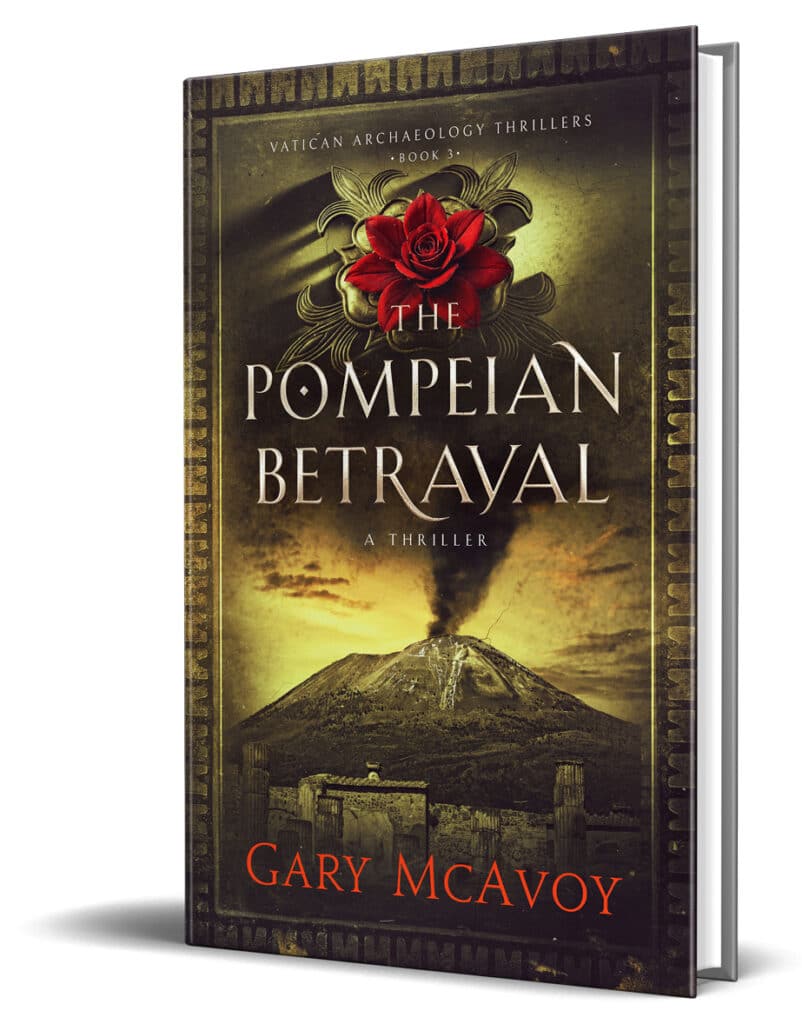
The Pompeian Betrayal
A Vatican Archaeology Thriller - Book 3
When Vatican archaeologist Marcus Russo receives an urgent call from Pompeii, he expects another routine excavation mystery. Instead, he finds something impossible: a hidden chamber containing symbols that predate their supposed origin by fifteen centuries. The seven-petaled rose, the geometric cross, the imagery that would become synonymous with Rosicrucianism—all of it painted on Roman walls decades before Vesuvius buried the city in ash. The discovery threatens to unravel one of history’s most enduring secrets: the Rosicrucian brotherhood wasn’t built on ancient wisdom passed down through the ages. It was built on a lie.
But powerful forces have protected that lie for four hundred years. The Fraternitas Rosae Crucis Aeternae will stop at nothing to bury the truth again—including burying Marcus and everyone who has seen the evidence. From the volcanic ruins of Pompeii to the shadowed halls of the Vatican, from Vienna’s elegant palaces to a besieged monastery in the Egyptian desert, Marcus and his team must outrun a conspiracy that spans centuries while decoding the teachings of a Roman philosopher who died rather than let his wisdom be corrupted. What Gaius Petronius Harmonia sealed in his underground sanctuary wasn’t just a meditation practice. It was a message: some truths are too dangerous to transmit—and too important to destroy.
The third installment in the Vatican Archaeology Thriller series, The Pompeian Betrayal weaves archaeological mystery, institutional conspiracy, and ancient philosophy into a pulse-pounding adventure that asks: What happens when the foundations of a centuries-old tradition are revealed as a magnificent mistake? And what wisdom might be waiting, patient and silent, for seekers brave enough to dig it up?
English
Published April 2026
English
Advance Reader Reviews

“First and foremost, a large thank you to Reedsy Discovery and Gary McAvoy for providing me with a copy of this publication, which allows me to provide you with an unbiased review.
Always a fan of Gary McAvoy and his work, I jumped at the chance to read the third novel in the Vatican Archaeology Thriller series. McAvoy uses his talents once again to highlight some great ideas and lesser-known finds, spinning them into a great story with much action and historical references.
While Marcus Russo has spent a career as a Vatican archeologist, he has discovered many mysteries that history has placed for him to interpret. He loves whatever he discovers, though when he is called to Pompeii to help unravel a recent find, he realises how problematic things could become. The discovery of a chamber with numerous symbols tied to the Rosicrucian tradition defies logic. How could these things buried under ash for two millennia have appeared before the Rosicrucian brotherhood began using them? Mysteries layer upon one another and Russo could be at the centre of a revelation like no other. Threats surface and a ruthless group, the Fraternitas Rosae Crucis Aeternae, will do whatever possible to secure control of the find, going so far as to kill. Add to this, Russo learns from Father Michael Dominic, the Vatican might have hidden truths centuries ago that could explain much of what the discovery asserts. What mysteries did a Roman philosopher hold that could shape modern mysteries and how will it all come together when the world learns the truth? One of the most intense novels Gary McAvoy has penned to date, this story pulls all angles together to deliver a stunning thriller!
While I have been enjoying the work of Gary McAvoy for a number of years, he never becomes overly repetitive. The ideas build off one another, never getting stale or becoming too simplistic. The narrative pushes the reader to feel a part of the entire process, enveloping them as they journey deeper into what is going on. Chapters speed by and leave the reader needing to know more, as they uncover truths and fictions one could not have predicted. McAvoy certainly moves away from all he has done with this piece that delves deeper and posits more before the final page turn.
Characters flavour the story well and keep the reader on edge as they seek to comprehend how everyone fits together. Marcus Russo has done well as protagonist, working angles that help intrigue the curious reader while also educating effectively. McAvoy uses some of his well-established characters from a tangential series, allowing those who have enjoyed his entire collection to feel connected to this piece. I cannot get enough of how McAvoy pulls on history and various perspectives to enrich the character base, all of whom flavour the larger story in ways that fuel curiosity.
The plot, while subtle in the early chapters, soon gains momentum and the reader finds themselves surrounded by great surprises and a thoroughly entertaining set of events. McAvoy layers history and education in ways that the attentive reader cannot help but want to forge onwards. McAvoy delivers a well-paced novel that never sheds too much light on fact and fiction until the final pages, which is another gem in his writing. I can only wonder where things are headed next and how Marcus Russo will shape future revelations.
Kudos, Mr. McAvoy, for proving your writing never lacks that spark I enjoy!”
—MATT PECHEY, Reedsy Discovery

Assessment:
Plot/Idea: In McAvoy’s gripping thriller, readers are privy to a shocking discovery that archeologist Marcus Russo and Director of Pompeii’s Archaeological Park Elena Vasari make in Pompeii’s ruins: the body of a Roman philosopher with ties to a mysterious brotherhood, long ago forbidden by the Catholic Church. What follows is high-stakes drama, hijacked artifacts, and a centuries-old mystery that some people will do anything to keep secret.
Prose: McAvoy skillfully layers history with action, with a jaw-dropping prologue that dumps readers in the middle of Mt. Vesuvius’s famously ancient eruption. Things only get hotter from there, with evocative scenes and convincing prose.
Originality: This mystery/thriller stuffed with conspiracies, a splash of romance, and more than a little philosophy tackles life, death, secrets, lies, betrayal, and two kinds of people: those who think knowledge is for all, and those who will kill to keep it secret. The result is an adventure-packed ride that neatly ties in history with action and suspense.
Character/Execution: As Marcus struggles against unknown forces trying to stop his work, he also learns valuable lessons about his own life and discovers a deeper sense of purpose. Several other characters are intriguing: Elena, Hana, von Staufen, and, of course Gaius, who looms large on every page—a good trick for a dead man. Readers will find it easy to differentiate them from each other; they all come across as individuals with their own agendas, who are responsible for their own decisions—for good or ill.
Score:
Plot/Idea: 8
Originality: 9
Prose: 9
Character/Execution: 8
Overall: 8.50
Report Submitted: August 31, 2026
“You know exactly what you’re going to get when you read Gary: intelligent storytelling, immensely well-researched attention to historical detail, and a top-quality production value. He is a professional at the top of his game, and The Pompeian Betrayal is another gripping entry in his series of puzzling historical mysteries – though in my view this has a touch more action than some others in the series.
Gary’s mysteries always have the same ingredients: a priceless ancient artefact, a deeply theological connection, a high-level, clandestine conspiracy, and his beloved team of amateur sleuths and their soldiers, always ready to put their lives on the line for the importance of historical preservation. I like this story, about a sadly doomed philosopher buried under the volcanic carnage of Mount Vesuvius two millennia ago, with evidence of the existence of a dangerously ideological religious order – which the team learns to their peril is still very determined in present times. As always with Gary’s work, there is a much broader ratio of fact to fiction. He is a great writer, to be sure, but his real star shines through his methodology and research; he is a genuine example to historical fiction writers…
As always, Gary has delivered another masterclass in his genre, again end-capped by a superb appendix of historical notes. Prolific and relentlessly high quality, I am in no doubt that he is already well into the team’s next adventure.” — MATT McAVOY, MJV Literary Reviews UK (no relation)
“I’ll make a bold claim and then defend it: this is Gary McAvoy’s masterpiece.
Those who’ve followed his work know that each novel carries something beneath the surface — spiritual, philosophical, and social truths woven quietly into the narrative. But The Pompeian Betrayal goes deeper than any of its predecessors. If I had to describe it in a phrase, I’d call it truth disguised as historical fiction.
The story draws on an astonishing range of elements: Pompeii, the Rosicrucians, sacred geometry, meditation, archaeology, murder, imprisonment, cover-up, exposure, Vesuvius, nobility, symbols, riddles, scrolls, tablets, medallions, and the particular madness of those who believe they alone possess the truth. What McAvoy accomplishes — and this is the art of it — is making all of these connect, intersect, and ultimately illuminate one another.
We think we know the story of Vesuvius and Pompeii in 79 AD. But what happens when a new discovery emerges that challenges not just the historical record, but the entire architecture of a belief system? Can a truth built on fabrication sustain itself indefinitely — and what occurs when that fabrication is finally exposed? Does one lose faith? Embrace a deeper, clarified understanding of it? Walk away entirely?
When I speak of faith here, I mean something larger than religion. I mean faith in society, in humanity, in philosophy. And when I do speak of spiritual faith, I mean all of it — the Bible, the Tripitaka, the Bhagavad Gita, the Vedas, the Quran, and the many other sacred traditions through which human beings have sought meaning. There is a distinction worth remembering: prayer is speaking to whatever divine source your path recognizes. Meditation is listening. And listening, as any honest practitioner will tell you, is far harder than speaking.
McAvoy has embedded within this novel a discovery — a hidden method for quieting the mind, focusing inward, and practicing what the mystics call the Presence. It arrives organically, through story, the way the best truths always do.
I’ll also mention, without giving anything away, that the novel includes a family reunion. That detail will mean more to you once you’ve read it.
Pay attention as you read. There is more here than plot. There is nourishment.” — RYAN SHAW, Advance Beta Reader
“The Pompeian Betrayal is Gary McAvoy at his most cinematic and most assured.
I’ve read the full ARC of this series, and this installment genuinely surprised me. It is tighter, bolder, and more emotionally layered than anything that has come before it.
What makes this book stand out is not simply the historical detail (which is, as always, meticulous), but the propulsion. The stakes feel immediate. The setting is immersive without being indulgent. And the moral tension — always a hallmark of McAvoy’s work — lands with real weight here.
There’s a confidence in the storytelling that feels earned. The characters are no longer simply navigating intrigue; they are confronting legacy, faith, power, and betrayal in ways that feel uncomfortably relevant to our own moment in history. There’s also something timely about this one. Themes of institutional power, buried truth, faith under pressure, and personal conscience feel especially resonant right now. It doesn’t preach — it provokes.
What impressed me most was the confidence. The book doesn’t over-explain. It trusts the reader. It allows the moral and theological tensions to breathe. The result is a story that feels both intimate and epic at the same time.
This is not just another Vatican thriller. It reads like a property that has grown into itself — deeper character work, stronger pacing, and a narrative engine that feels built for a much larger canvas. If you’ve followed this series, you’ll recognize how far the storytelling has come. If you’re new, this book stands confidently on its own.
This is what happens when a writer fully inhabits his world and trusts his audience to go with him. It’s bold. It’s layered. And it stayed with me long after I finished the final page.”
— MICHELLE HARDEN, Principal, Koru, Inc.


