
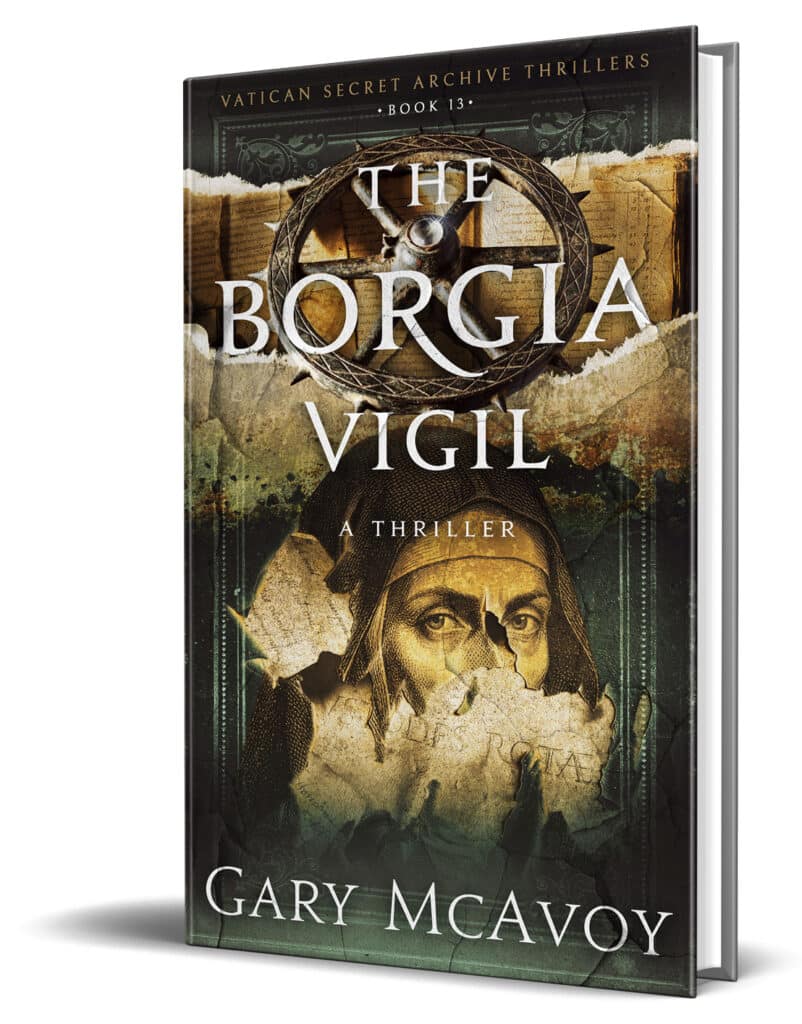
The Borgia Vigil
A Vatican Secret Archives Thriller – Book 13
Father Michael Dominic is six weeks from his wedding when a restorer dies inside the Borgia Apartments, and a sealed niche behind Pinturicchio’s frescoes surrenders a five-hundred-year-old secret: a ledger, a founding charter, and a reliquary pendant cataloging one hundred and eleven objects spirited out of Rome in the dying hours of Alexander VI’s pontificate. The documents name a trafficking confraternity—the Sisters of the Sacred Vigil—chartered to move Borgia assets into the shadows and never disband. They never did. Their modern prioress, Mother Superior Agnese Visconti, is a former military intelligence operative who views the late Pope Ignatius’s marriage reform as an act of desecration and Michael as its most visible offense. She wants the ledger. She wants the reliquary. She intends to take both before the wedding can happen. If it happens…
The investigation pulls Michael and Hana from the Vatican’s underground Scavi to a centuries-old convent in the Umbrian hills, from a clandestine staging chamber beneath St. Peter’s Basilica—where an inscription carved into the stone reads Custodes Rotae: Keepers of the Wheel—to the deck of a Lebanese collector’s yacht in Civitavecchia harbor. Michael recovers the reliquary. Agnese disappears through a port window and into arrangements she made weeks before anyone knew to look for them.
The endgame moves to Hana’s villa in Èze, where Agnese has been a ghost among the wedding guests for thirty-six hours before anyone sees her face in a mirror. What follows is equal parts reckoning and ceremony—a fight for a five-century chain of stolen custody, resolved under the olive trees of the Côte d’Azur. The Borgia Vigil is the thirteenth Vatican Secret Archive Thriller, and the one in which Father Michael Dominic finally gets married—provided the Wheel stops turning long enough to let him.

“McAvoy’s crisp prose handles historical detail, investigation, and action with ease. His precise descriptions bring Vatican settings and artifacts to life, while tense dialogue and clearly staged action keep the story moving.” (The Borgia Vigil) — The BookLife Prize, 2026

Before this series began, I never imagined I’d become so invested in Vatican history, Church doctrine, and the lives of a priest and an art historian. Thirteen novels later, Gary McAvoy has made all three feel inseparable. This latest instalment is another confident blend of historical intrigue, theological debate, and character-driven storytelling that rewards long-time readers while once again proving why the Vatican Secret Archives series stands among the finest religious thrillers being written today.
Gary McAvoy has become my go-to author for intelligent thrillers that blur the line between Church history and compelling fiction. Once again, he dives into obscure Vatican secrets with remarkable confidence, building a story around hidden Borgia relics, centuries-old conspiracies, and the dangerous consequences of challenging established doctrine. The novel asks difficult questions about tradition, reform, and whether the preservation of faith sometimes comes at the expense of truth. Rather than taking cheap shots at Catholicism, McAvoy crafts a nuanced exploration of the Church’s internal struggles, allowing competing beliefs to collide in thoughtful and believable ways. The theological debates never overwhelm the narrative, instead enriching a thriller that constantly reminds readers why these historical secrets continue to fascinate.
One of the novel’s greatest strengths is its storytelling. While previous entries often leaned heavily into relentless action, this instalment embraces a slower, more methodical pace that proves equally gripping. The investigation unfolds through careful discoveries, hidden documents, secret societies, and moral dilemmas instead of endless gunfire or high-speed chases. The tension comes from knowing what is at stake rather than simply how dangerous each moment becomes. McAvoy trusts his readers to appreciate a more cerebral thriller, allowing suspense to build naturally as each revelation peels back another layer of a conspiracy that has survived for more than five centuries. It is a different rhythm than some earlier books, but one that fits the subject matter perfectly.
Series fans will undoubtedly find the emotional heart of the novel in Father Michael Dominic and Hana Sinclair. Their relationship has been quietly developing since the opening novel, making the approach of their wedding feel genuinely earned rather than simply another plot device. Watching these two balance the excitement of matrimony with yet another Vatican mystery is immensely satisfying, particularly because McAvoy never loses sight of the personalities that have made them such enduring protagonists. Their partnership has always been built on mutual respect, intellectual curiosity, and unwavering trust, and those qualities shine brighter than ever here. For readers who have invested thirteen novels in their journey, the emotional payoff is every bit as rewarding as uncovering the latest Vatican secret.
McAvoy also continues to excel at constructing layered supporting casts. Familiar faces return with purpose, while new allies and adversaries slot seamlessly into the larger mythology of the series. Mother Superior Agnese Visconti is an especially memorable antagonist because her motivations extend well beyond greed or power. She genuinely believes she is protecting the Church from dangerous reform, making her ideological conflict with Father Dominic every bit as compelling as the physical danger she presents. Those shades of moral ambiguity elevate the novel well above a conventional conspiracy thriller.
As always, the plotting is meticulously crafted. Twists emerge organically from historical discoveries rather than manufactured surprises, and the seamless blending of documented history with imaginative speculation remains one of McAvoy’s defining talents. Like Steve Berry and Dan Brown at their very best, he leaves readers questioning where the historical record ends and the fiction begins. Yet McAvoy has long established his own voice within this genre, one that values historical authenticity, theological nuance, and emotional investment equally.
Although newcomers could certainly enjoy this novel on its own, I would strongly encourage beginning with the first book. Few series reward long-term readers as generously as the Vatican Secret Archives. Character arcs, recurring relationships, and the gradual expansion of McAvoy’s Vatican mythology have been building for thirteen novels, and this latest entry delivers one of the most satisfying payoffs yet. It is thoughtful rather than explosive, deeply rooted in questions of faith and doctrine, and anchored by two protagonists whose journey together has become just as compelling as the mysteries they solve. Gary McAvoy continues to prove that history’s greatest secrets are often best explored through fiction, and I cannot wait to see what lies hidden in the Vatican’s shadows next.
Kudos, Mr. McAvoy, for an intensity that opens doors to new possibilities with this series or a new offshoot. — MATT PECHEY, Reedsy Discovery


