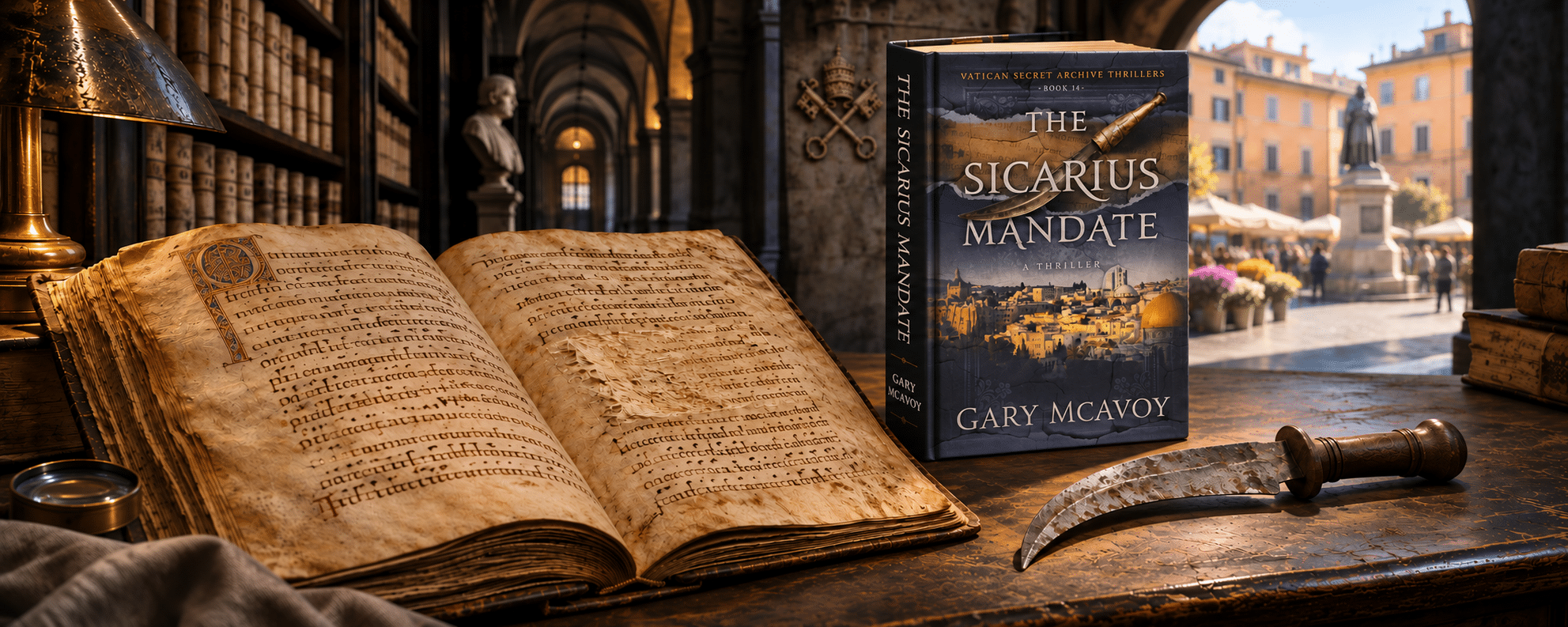
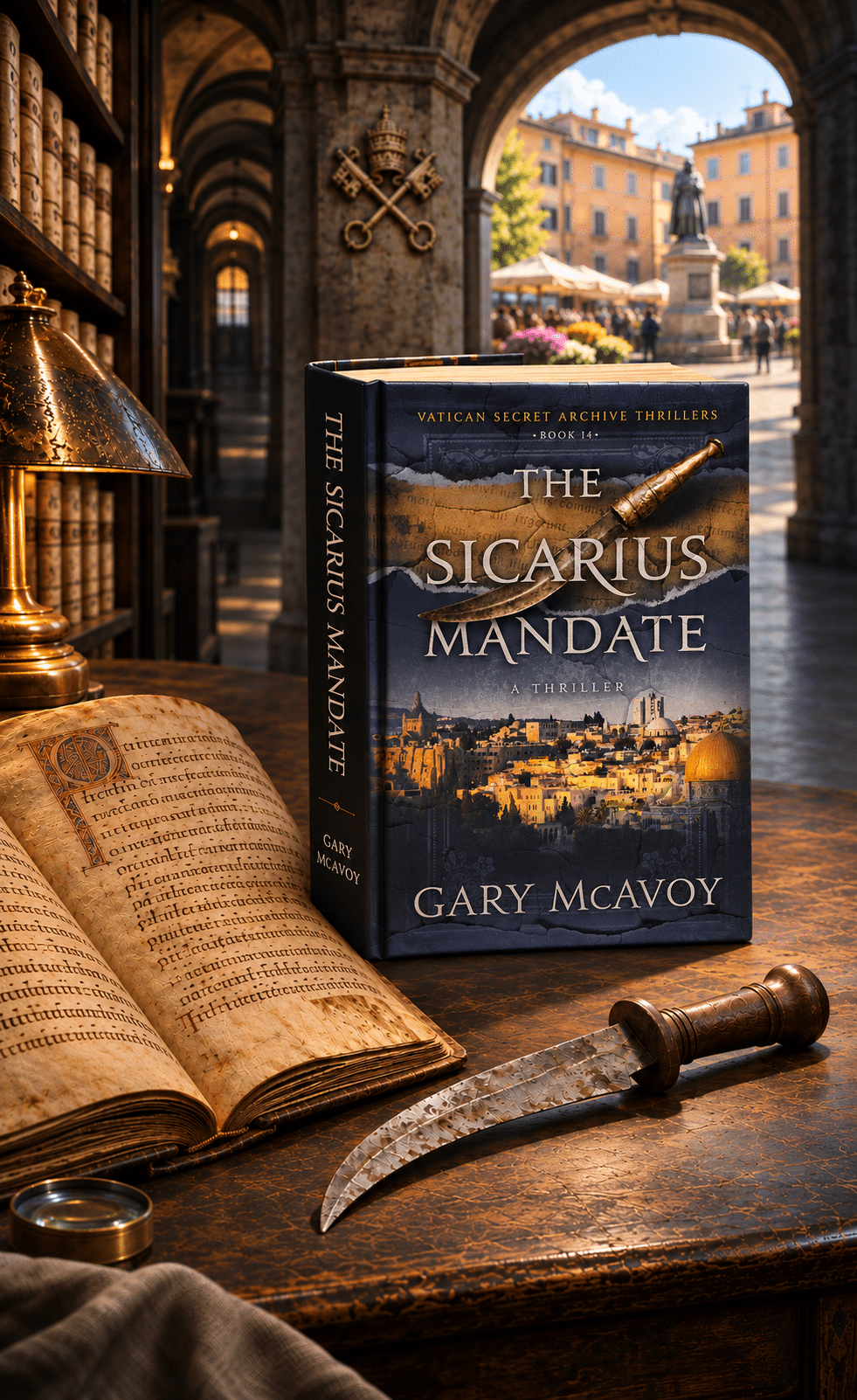
A blessing for the dead. Spoken over the living.
On a bright April morning in Rome’s Campo de’ Fiori, an elderly paleographer is jostled in a crowd, walks eleven steps, and sits down among the flower buckets to die. A stranger kneels beside him, cradles his head, and murmurs the Hebrew blessing said only over the dead. Eleven witnesses give eleven different descriptions of the man. They agree on just one thing.
He was kind.
That afternoon, in the Vatican Apostolic Archives, Father Michael Dominic finds that the dead scholar’s manuscript has already been returned to the vaults, logged on a reader’s card that is sitting in a police evidence bag across the river. The codex is a medieval Latin translation of a testimony from first-century Jerusalem, signed by a man who calls himself Sicarius XIII. Under ultraviolet light, four words on its final page reveal themselves as a forgery, scraped and rewritten by a Benedictine monk eight centuries ago. In the same box lies a curved iron blade, catalogued in 1868 as a Roman pruning knife.
It curves the wrong way for pruning.
Michael’s wife, journalist Hana Sinclair, received the scholar’s final email forty minutes before he died. It asked a single question: Who owned this manuscript in 1868, and who was paid? The answer will draw them from the Secretariat of State to the cliffs of Masada and a silent Carthusian monastery in Calabria. It will also put Hana in the path of a killer who has no plan to escape and no fear of dying.
What they uncover reaches back to the murder of James the Just, the flight of Jerusalem’s first Christians, and an office handed down at deathbeds for two thousand years. At its center is one word, mistranslated in the year Jerusalem fell to Saladin, and every holder of that office has obeyed it ever since.
Watch the Book Trailer
Discover what readers are saying...
“Insert editorial pull quote here.” — Reviewer name, publication